
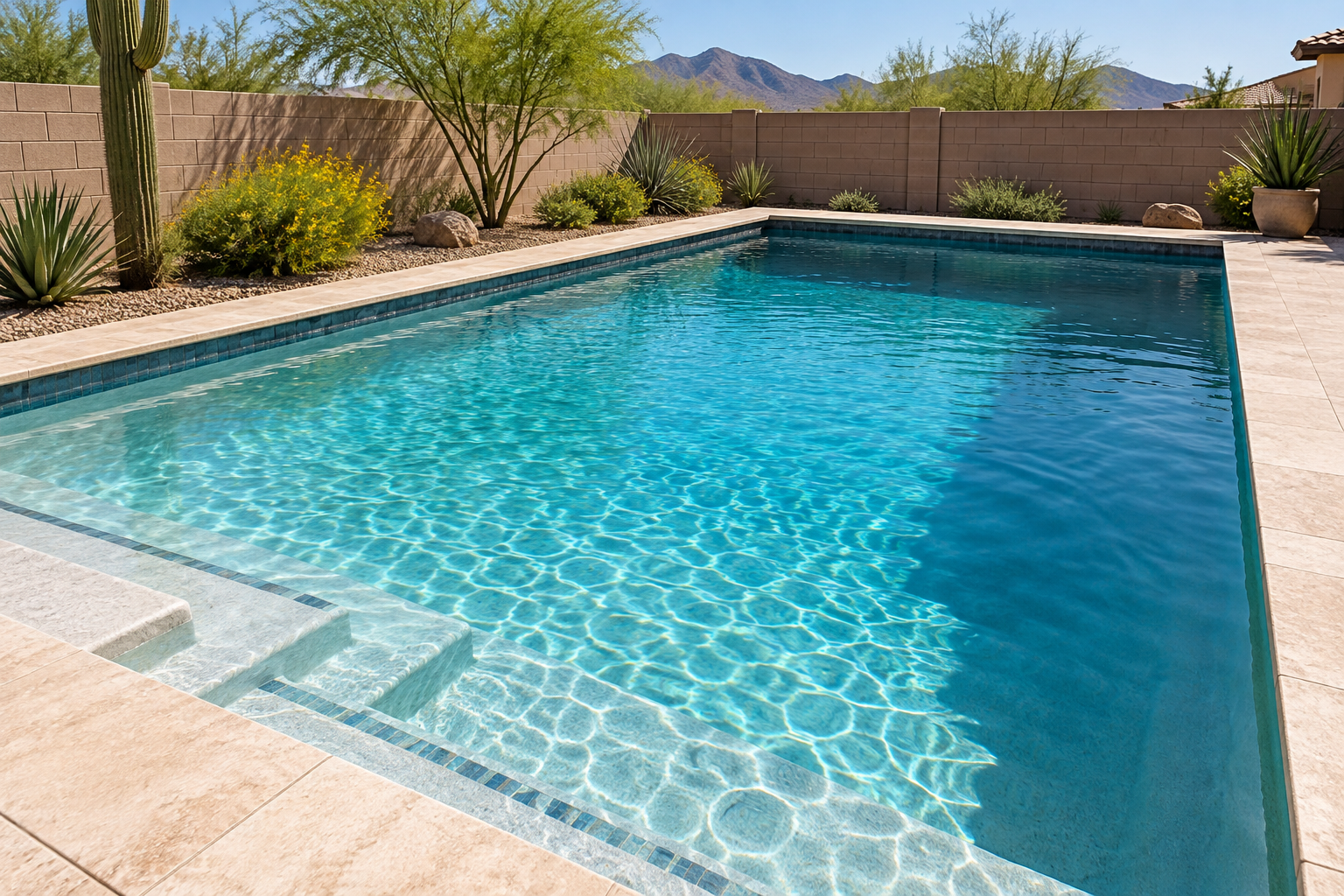
I live in Arizona. Pools here aren’t a luxury. They’re how you survive July.
My brother runs a pool company, and lately I’ve been building software for that world. So I’ve spent a lot of time around one simple question.
How many gallons is this pool?
Here’s the thing. Most owners don’t actually know. They got a number from the builder, the last owner, or a guess. Then every chemical dose they add is built on that number.
If the number is wrong, everything after it is wrong too.
Let me walk you through how to get it right.
The Short Version
For a rectangle pool:
Gallons = length × width × average depth × 7.5
Measure in feet. The 7.5 is how many gallons fit in one cubic foot of water.
Round and oval pools use a different number, and I’ll cover those below.
Don’t feel like doing math? Use this free pool volume calculator. Plug in your shape and measurements and it does the rest.
Start With Average Depth
Most pools don’t have one depth. They slope from a shallow end to a deep end.
So you need the average:
Average depth = (shallow end + deep end) ÷ 2
A pool that’s 3.5 feet at the shallow end and 8 feet at the deep end has an average depth of 5.75 feet.
Pro tip: measure to the water line, not the top of the wall. Above ground pools are usually filled about 6 inches below the top. If you use wall height, you’ll overcount by hundreds of gallons. Sometimes thousands.
How to Calculate Gallons by Pool Shape
Rectangle
Length × width × average depth × 7.5
Example: a 16 × 32 pool, 3.5 feet shallow, 8 feet deep.
16 × 32 × 5.75 × 7.5 = 22,080 gallons
Round
Diameter × diameter × average depth × 5.9
Example: a 24 foot round above ground pool with a 52 inch wall. The water sits about 46 inches deep, or 3.83 feet.
24 × 24 × 3.83 × 5.9 = about 13,030 gallons
Oval
Length × width × average depth × 5.9
Example: a 15 × 30 oval with 4 feet of water.
15 × 30 × 4 × 5.9 = 10,620 gallons
Kidney and Freeform
These are the tricky ones. Here’s the common shortcut:
(A + B) × length × average depth × 0.45 × 7.5
A and B are the widths of the two rounded ends. Measure each at its widest point.
Example: ends of 10 and 14 feet, 30 feet long, 5 foot average depth.
(10 + 14) × 30 × 5 × 0.45 × 7.5 = 12,150 gallons
Freeform pools are always an estimate. If yours has a weird shape, split it into simple sections, figure each one, and add them up.
Above Ground Pools
Same formulas. Round uses the round formula. Oval uses the oval one.
The only difference is depth. Use the water depth, not the wall height. A 48 inch wall usually holds about 42 inches of water. A 52 inch wall holds about 46.
How Many Gallons Is My Pool? Common Sizes Chart
These assume above ground pools are filled 6 inches below the wall, and inground pools have a 5 foot average depth. Your real number will move with your actual depth.
Above ground pools
| Pool size | 48″ wall | 52″ wall |
|---|---|---|
| 12′ round | 2,970 | 3,260 |
| 15′ round | 4,650 | 5,090 |
| 18′ round | 6,690 | 7,330 |
| 21′ round | 9,110 | 9,970 |
| 24′ round | 11,890 | 13,030 |
| 27′ round | 15,050 | 16,490 |
| 15′ × 30′ oval | 9,290 | 10,180 |
| 18′ × 33′ oval | 12,270 | 13,430 |
Inground pools (5 ft average depth)
| Pool size | Gallons |
|---|---|
| 12′ × 24′ | 10,800 |
| 15′ × 30′ | 16,875 |
| 16′ × 32′ | 19,200 |
| 18′ × 36′ | 24,300 |
| 20′ × 40′ | 30,000 |
Different depth? Take the chart number, divide by 5, and multiply by your average depth. Or just use the pool gallons calculator.
How Many Gallons Is the Average Pool?
A typical backyard inground pool lands somewhere between 15,000 and 25,000 gallons. The classic 16 × 32 sits right around 19,000 to 20,000.
Above ground pools are usually smaller. Most fall between about 3,000 and 15,000 gallons, depending on the diameter and wall height.
But “average” doesn’t help you dose chemicals. Your pool isn’t average. It’s yours. Measure it.
Why Your Gallon Count Actually Matters
This is the part the calculators skip.
Your gallon number is the starting point for almost everything:
- Chlorine and shock. Every dose on the label is written per gallon of water.
- Salt pools. Salt targets are set in parts per million, which depends on volume.
- Pump run time. You want all the water to cycle through the filter every day. You can’t plan that without knowing how much water there is.
- Fill and top off cost. In an Arizona summer, you’re adding water all the time. It helps to know what a full refill really costs.
Here’s how a bad number plays out.
Say you think your pool is 20,000 gallons. It’s really 15,000. Every dose you add is about a third stronger than you meant it to be. Do that every week and you’re paying for chemicals you don’t need. Worse, you’re chasing numbers that never line up.
It goes the other way too. If your pool is bigger than you think, you’re under dosing. That’s how algae shows up even when you’re “doing everything right.”
What I Heard Pool Owners Say
I went looking for real examples. They weren’t hard to find.
On the TroubleFreePool forum, one owner had a 16 × 32 pool with a deep hopper bottom. Every online calculator said about 21,200 gallons. He shocked based on that number and his chlorine came in higher than he planned. Then he found the original install manual. It listed the pool at 18,350 gallons, about 13% less than the calculators said.
Why? The sloped walls of a deep hopper hold less water than a simple average assumes.
Another new homeowner on the same forum was told by the previous owner that his pool held 40,000 gallons. He measured it carefully and built a 3D model. His real number came out around 22,400. Nearly half.
Imagine dosing for 40,000 gallons when you only have 22,000.
How to Check Your Number
If your math and your water tests don’t agree, trust the tests. Here’s a simple check:
- Test your free chlorine.
- Add a measured dose that should raise it by a set amount for your gallon count.
- Let the pump run a full cycle, then test again.
If the level jumped higher than expected, your pool is smaller than you think. If it barely moved, it’s bigger. Adjust your number and try again next time.
The Wrap Up
Your pool’s gallon count is the one number everything else depends on.
Measure once. Use the right formula for your shape. Then write the number down somewhere you’ll see it every time you buy chemicals.
If you want a shortcut, the pool gallons calculator handles round, oval, rectangle, and kidney shapes in a few seconds.
So what’s your pool’s number? Did you actually measure it, or are you still using the one the last owner gave you?